AI for Property Management: Maintenance Requests on WhatsApp, Instant Answers for Residents and Less Admin
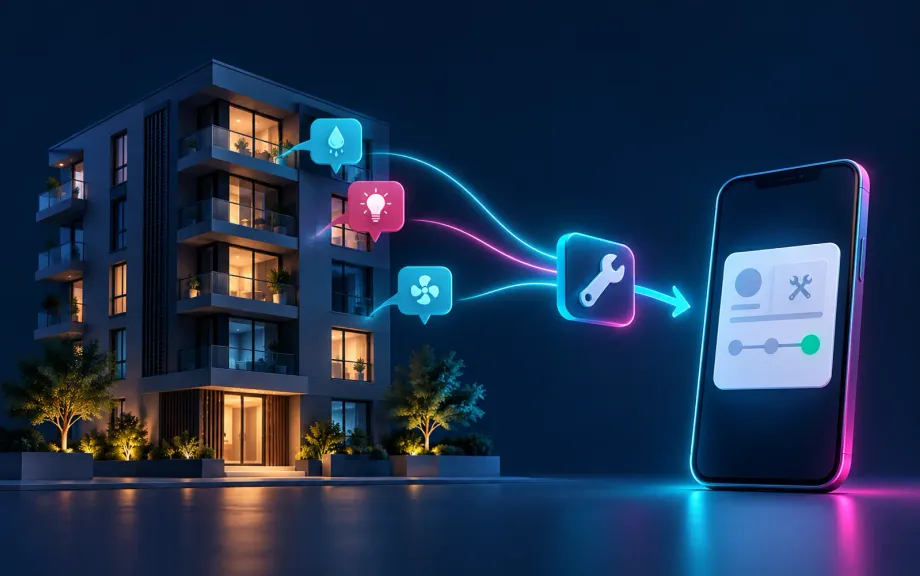
If you manage rental homes or residential blocks, you know how the day goes: a leak reported by text at 11 pm, the same question about service charges from five different residents, a contractor who never confirmed, and an owner asking for a report you haven’t had time to write. Most of it is not hard work. It’s repetitive, it arrives on every channel at once, and it eats the hours you need for the decisions that really are yours.
The short answer
- What AI can take over: logging maintenance requests from WhatsApp, text or email as structured tickets (photos, unit, urgency), sending them to the right contractor and keeping the resident updated; answering routine questions from the building’s own documents; drafting meeting minutes, notices, arrears reminders and owner reports; sorting your inbox.
- What it saves: the hours spent copying messages into your software, chasing contractors and repeating the same answers. Decisions about money, legal disputes and difficult residents stay with you.
- What it costs: an assistant that answers from your documents starts at around €1,000; an agent connected to 1–3 of your tools (property management software, email, contractor list) is €2,000–5,000; one working across several systems or answering phone calls starts at €5,000. Usage is usually cents per conversation.
- How to start: pick the process with the most volume (almost always maintenance requests), run it with a person approving every message for the first weeks, then give the agent more autonomy where it proves reliable.
What you can automate in property management
Most AI property management software sold today is a module inside a larger platform, focused on leasing enquiries in the US market. That’s useful if you’re on that platform. If you run a mix of tools, manage blocks as well as lettings, or your residents talk to you on WhatsApp, the value usually comes from connecting what you already use and putting AI at the points where messages turn into work.
| Process | What AI and automation do | Who benefits |
|---|---|---|
| Maintenance requests | Turn a WhatsApp message, photo or voice note into a ticket with unit, category and urgency; dispatch the right contractor; follow up and notify the resident | Residents, property managers, contractors |
| Resident and tenant questions | Answer service charge, rules, bin days, meeting dates and document requests from the building’s own documents, 24/7 | Residents, front office |
| Meetings and minutes | Transcribe the recording, draft the minutes and the follow-up notices | Block managers, boards |
| Arrears | Send polite, personalised reminders on schedule and escalate to a person when needed | Accounts, owners |
| Lettings admin | Pre-qualify enquiries, collect application documents, extract key dates from leases, chase renewals | Lettings team, landlords |
| Owner reports | Write the monthly summary from tickets, costs and occupancy, ready to review | Landlords, owners, boards |
| Email triage | Classify and route incoming email, draft the reply, flag what’s urgent | Everyone in the office |
Maintenance requests: from a WhatsApp message to a closed ticket
Before: a resident sends “water coming through the ceiling in the bathroom” with two blurry photos. Someone in the office reads it an hour later, phones to ask which flat, copies it into the system, calls two plumbers, forgets to tell the resident anyone is coming, and gets a second, angrier message the next morning.
After: the agent replies within seconds, asks the questions a good coordinator would ask (which unit, is water still coming in, is there anything electrical nearby, can you send a photo of the ceiling), and creates a ticket with the photos, location, category and urgency. Urgent cases follow your out-of-hours rules: the on-call person is alerted immediately and the resident gets the steps to take now (turn off the stopcock, keep away from the light fitting). Routine jobs go to the contractor assigned to that building and that trade, with the details and photos attached. When the contractor confirms or closes the job (with a photo), the resident is told, and the ticket shows the whole history.
This is the same pattern we built for a gardening company that looks after the grounds of more than 40 hotels: voice notes from the field turned into structured incidents by AI, tasks closed with photo proof, and the right people notified automatically. Swap gardeners and hotels for contractors and residents, and the workflow is almost identical.
Answering residents from the building’s own documents
Before: “When is the AGM?”, “What does my service charge cover?”, “Can I put a satellite dish on the balcony?”, “Can you send me the insurance certificate?” Each one takes a few minutes, and they come in all day.
After: the agent answers from the documents of that specific building or tenancy: rules, budget, insurance policy, meeting notices, the lease. It quotes where the answer comes from and sends the document when the person is entitled to it. This technique, where the AI searches your documents before answering, is called RAG; we explain it in our guide to local AI and RAG for business. Anything that isn’t in the documents, or that sounds like a dispute, goes to a person with the conversation attached.
Meeting minutes and notices from the recording
Before: after an evening meeting, someone spends the next morning turning notes into minutes, then writes separate notices for the decisions taken.
After: the meeting is recorded (with everyone informed), transcribed and drafted into minutes in your usual format: attendance, each agenda item, what was agreed and how people voted. The AI also drafts the follow-up notices. You review, correct and sign. AI is good at the first draft and bad at knowing what is legally significant, so the review stays with you.
Arrears reminders that are polite, on time and private
Before: reminders go out when someone remembers, in a tone that depends on the day, and occasionally to the wrong person.
After: reminders go out on a schedule, personalised with the amount and the period owed, to that owner or tenant only. After a set number of reminders, or if the person replies with a problem (“I’ve lost my job”, “that charge is wrong”), the case goes to a person. Nothing about one person’s debt is ever posted where other residents can see it.
Lettings: enquiries, applications and leases
Before: enquiries arrive on portals, email and phone; half never get an answer the same day; application documents arrive in pieces.
After: the agent answers enquiries about the property, checks availability and basic requirements, books viewings, and collects the application documents in one place. AI reads leases and extracts the dates that matter (break clauses, renewals, rent reviews) so reminders go out on time. The decision to accept or reject an applicant stays with a person, with consistent written criteria. Fair housing and anti-discrimination rules apply to those decisions whoever, or whatever, makes them.
Owner reports written by AI
Before: monthly or quarterly reports to landlords or boards are built by hand from the ticketing system, the accounts and a pile of emails.
After: the report assembles itself from tickets resolved, costs, open issues and occupancy, and AI writes the narrative: what happened, what it cost, what’s pending. In the gardening platform above, this turned hours of work per client into a review.
What a typical rollout looks like
- Map the processes (one or two workshops). Who receives what, on which channel, which contractor covers which building and trade, what counts as urgent, who’s on call. Most of the value comes from writing this down.
- First process: maintenance requests, with a person approving every message the agent sends for the first weeks. We save every conversation and review the ones that go wrong.
- Give it autonomy where it earns it. Not every message needs the same treatment. We use Jev, a decision model from TypeSafe that returns probabilities instead of text, to decide whether a reply can go out on its own or needs a person: “the contractor is booked for Thursday morning” can be sent automatically; a complaint, a compensation request or anything about a dispute goes to a person.
- Second process: resident questions from documents, which reuses the same channel and the same logs.
- Then the back office: minutes, arrears, owner reports and email triage, each as a separate step you can measure.
What still needs a person: emergencies (the agent alerts, a human decides), anything legal or contentious, decisions about tenants and money, and the relationship with your boards and landlords. AI takes the copying, chasing and first drafts.
The risks of doing it alone
AI in property management touches people’s homes, their money and their personal data, so mistakes are visible and expensive. These are the ones we see most:
- Personal data of residents and tenants. Names, phone numbers, arrears, ID documents and lease details pasted into a free chatbot, or sent to a model that keeps or trains on them. Under the GDPR (or UK GDPR) you’re responsible for where that data goes. For EU clients we use models processed in Europe, with zero data retention and no training on your data; more in our guide to EU data residency for AI models.
- A message sent to the wrong owner. An agent that confuses two flats with similar numbers, or two residents with the same surname, can send one person’s arrears notice to another. That needs strict matching of phone numbers to units, and tests with real cases before launch.
- AI answering legal questions wrongly. “Can my landlord keep my deposit?” or “Can the board ban short-term lets?” are not questions an assistant should answer from general knowledge. A well-built agent only answers from your documents and hands everything else to a person.
- Contractor dispatch errors. Sending a plumber to an electrical fault, a contractor to the wrong building, or treating a gas smell as routine. Urgency rules have to be explicit, tested and conservative.
- The WhatsApp number residents rely on. A connection through a regular number (Evolution API) has no per-message fees and works well for one-to-one conversations; the official WhatsApp Business API is the route for large volumes and broadcast notices. If the number your residents depend on gets blocked, your maintenance line goes silent. We compare both in Evolution API vs the official WhatsApp Business API.
- Silent failures. An integration with your property management software that stops working on a Friday night and nobody notices until Monday. Every agent we build logs every conversation, and failures raise alerts.
An experienced partner doesn’t make these risks disappear, but knows where they are before the first resident writes in.
Want to see what this would look like for your buildings? Book a free call and tell us how requests reach you today.
How we do it at Aitomatik
- We start from your process, not from a tool. If your property management software already does something well, we connect to it instead of replacing it. When nothing on the market fits, we build it: see our custom software development with AI.
- We’ve built the pattern before. The hotel gardening platform handles incidents with photos, notifications to the right people and AI-written monthly reports for 200+ gardeners across 40+ hotels. For a multi-company group we mapped 75 processes and freed more than 1,600 hours a year, including reports for local councils that went from 3–4 hours to 30–45 minutes of review.
- WhatsApp that fits the use case. We use the official API or Evolution API depending on volume and risk. In a project we’re building for a domestic staffing agency, the WhatsApp agent talks to candidates with no per-message cost.
- Every conversation saved and evaluated. We test changes against real conversations before shipping them. A dashboard where your team can read conversations and take over a chat is optional.
- Clear prices. The tiers above come from our guide to how much an AI agent costs. If you’re new to the idea, start with what an AI agent is.
We’re open to projects with lettings agents, block and community managers, HOA management companies and landlords running their own portfolio, in Spain, Europe and beyond. The use cases on this page are what we’d build, not a list of past property clients. Related pages: AI for home services and field service companies, AI and automation in real estate and all our guides.
Frequently asked questions
How is AI used in property management? Mostly in four places: handling maintenance requests (logging, triage, dispatch and updates), answering residents and applicants, drafting documents (minutes, notices, reports, lease summaries) and back-office work such as email triage, arrears reminders and invoice reading. The best results come from connecting these to the software you already use.
Which AI is best for property management? There isn’t one. All-in-one platforms include AI features that work well inside their own ecosystem, especially for leasing. General assistants like ChatGPT or Claude are good for drafting, but shouldn’t receive residents’ personal data on a free plan. For maintenance and resident communication across several tools and channels, a custom agent connected to your systems usually fits better.
Is AI going to replace property managers? No. It replaces the copying, chasing and repeating. Emergencies, disputes, board relationships, judgement about people and money stay with the property manager, who gets more time for them.
What is the best AI property management software? It depends on what you already use. If your platform has an AI module that covers your main bottleneck, try that first. If your residents use WhatsApp, you manage both blocks and lettings, or your processes cross several tools, connecting them with an agent built around your workflow is usually more effective than switching platforms.
How much does AI for property management cost? For a custom build: from around €1,000 for an assistant that answers from your documents, €2,000–5,000 for an agent connected to 1–3 tools, and from €5,000 for multi-system or voice agents. Usage costs are usually cents per conversation, plus WhatsApp fees if you use the official API.
Is it safe to let AI talk to tenants? Yes, with limits: it answers only from approved documents, it identifies itself as an AI, it hands anything legal, urgent or contentious to a person, and every conversation is logged and reviewed.
Let’s look at your maintenance line first
Tell us how requests and questions reach you today, which software you use and where the hours go. We’ll tell you what we’d automate first and what it would cost. See our AI-powered customer service or book a free call.
Guide prices for small business projects as of October 2026. Last reviewed: 15 October 2026.