Success Story: A WhatsApp AI Agent and Custom CRM for a Domestic Staffing Agency
At a glance
- Candidate screening on WhatsApp, at any hour, against each job’s requirements
- CVs as PDFs or photos, and voice notes, read automatically to fill in the candidate’s profile
- Jobs posted to WhatsApp groups at the frequency the agency chooses, with no per-message cost
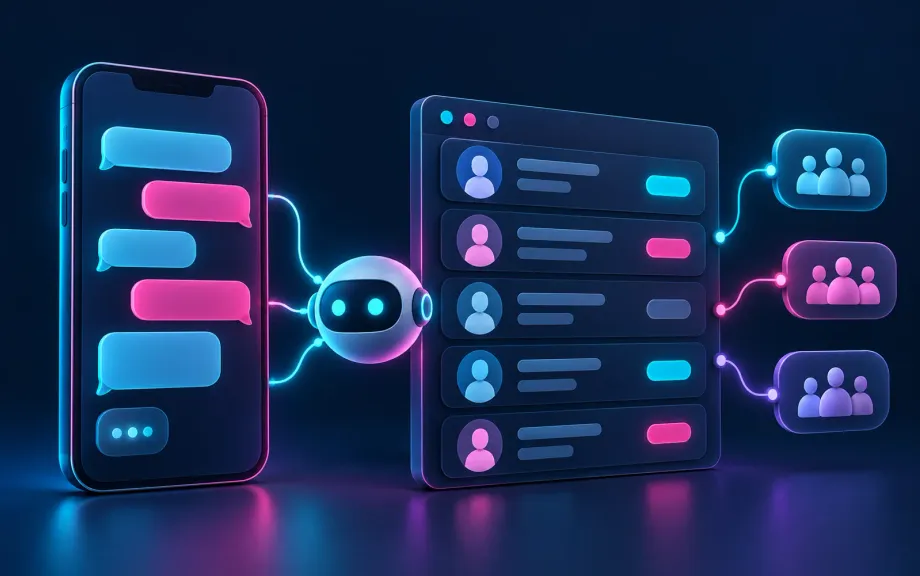
- One inbox where the team sees everything the AI does and can take over any conversation
- The team’s own Claude or ChatGPT connected to the CRM, to query and update it by talking
- Data and AI models processed in Europe, with GDPR-compliant consent and retention
The client
A domestic staffing agency placing nannies, housekeepers, elderly carers, cooks and live-in couples with families in several cities. A small team that knows its candidates and families well, and does almost all of its work on WhatsApp.
The challenge
The same work repeated every day:
- Jobs posted by hand to several WhatsApp groups, one by one, several times a day.
- A steady stream of private messages from interested candidates, many with the same questions.
- Most weren’t a fit for objective reasons: work permit, travel time to the home, experience or languages. But each one had to be asked before anyone knew.
- CVs as photos, PDFs and voice notes, read and typed into a spreadsheet by hand.
- A spreadsheet as the CRM, with no history of who said what or why someone was turned down.
The goal they set us was clear: the team should only talk to candidates who already meet the job’s requirements, and have their CV and details before calling them.
What we built
A custom CRM for the agency
Jobs, candidates, families, WhatsApp groups and applications, with each candidate’s status for each job: new, screening, ready for interview, discarded (with the reason), interviewed, sent to the family, hired. Each job has public fields (what gets posted) and private ones (the address, the family’s details), clearly separated.
An AI agent that screens on WhatsApp
When a candidate messages the agency’s number, the agent:
- Tells them they’re talking to an AI assistant and asks for consent to process their data, conversationally.
- Asks for whatever is missing for the job they’re interested in: work permit, area, transport, experience, languages, availability.
- Reads their CV if they send it as a PDF or a photo, and transcribes their voice notes. It fills in the profile with everything the document supports.
- Checks the job’s requirements. The objective filters (work permit, maximum travel time) are checked in code, not in the AI’s instructions: the agent can’t mark someone as a fit if they don’t meet them.
- Ends with a clear outcome: ready for interview (and it asks when they’d like to be called) or discarded with the reason, with a kind message, mentioning another job if one fits.
If the candidate asks something the agent can’t answer, complains or asks for a person, it hands the conversation to the team with the reason.
Posting to groups and sending jobs to candidates
- Automatic posting of active jobs to the WhatsApp groups, within time windows and at each group’s frequency, with random gaps so it doesn’t look like a bot.
- New jobs sent to candidates who opted in, filtered by requirements, always after the team confirms.
- Reminders to anyone who leaves a conversation half-finished, never at night and with a cap.
We connected the agency’s WhatsApp through Evolution API, with no per-message cost and access to the groups that already existed. We explain the trade-offs in our comparison of Evolution API and the official WhatsApp Business API.
The summary for the family
When a candidate passes the interview, the platform drafts a summary for the family with their profile, experience and the interview notes, tailored to the job. It never includes their phone number, exact address, documents or referees’ details. The team reviews it, edits it if they want and sends it.
People stay in charge
The AI does the repetitive work, but the team decides:
- One inbox with every conversation, including the ones the AI is handling, each clearly labelled: AI, manual or waiting for a person.
- Take over in one click. The AI stops instantly. If someone replies from the agency’s own phone, the platform detects it and switches the conversation to manual automatically.
- Where each detail came from. Every field the AI fills in shows its source (a message, the CV, a voice note, a document), with a link to the message and a button to undo it.
- Notes by voice. After an interview, the team dictates their notes and the platform updates the candidate’s profile, showing which fields changed.
Security and data protection
- Data and AI models processed in Europe, with zero data retention by the AI providers, and a backup model from a different provider: if the main one fails, screening doesn’t stop.
- What the AI can’t see: the family’s address and private details never reach the agent. It can save an ID document number if the candidate sends one, but can’t read it back, so it can’t leak it even if someone tries to manipulate it.
- Candidate content is treated as data, not instructions, so a message or a CV can’t hijack the agent.
- Consent, opting out of job alerts and 5-year retention, with deletion on request.
- Tests before every change: a set of real, anonymised conversations is replayed against each new version of the instructions, on both the main and the backup model.
The CRM inside the team’s Claude or ChatGPT
We connected the platform to the team’s AI assistant through an MCP server. From their own Claude or ChatGPT they can ask “which candidates with work permits in Madrid have experience with babies?”, create a job by dictating it, or check the week’s numbers. Each person signs in with their own user, everything is logged, and nothing irreversible can be done from there: sensitive actions need explicit confirmation and the assistant never messages candidates.
How we worked
- A kick-off with the team to understand how they work today, using their real conversations, spreadsheet and texts.
- A detailed specification of the platform, validated with them, with open decisions in plain sight.
- Phased development, testing each part with simulated conversations before connecting WhatsApp.
- Testing with the team trying to break it in a test group, then a progressive launch: one job and one group first, then the rest.
Project status
The platform is built and in final testing with the team, ahead of a progressive launch with real jobs. We’ll update this case study with results as soon as we have real usage data.
Key takeaways
- Objective filters belong in code. The AI talks and extracts data; the rules that can’t be bent are checked by the system.
- WhatsApp is where candidates are. Running the process there, instead of sending them to a form, is what gets replies.
- Unsupervised AI isn’t an option. A clear inbox, one-click takeover and the source of every detail are what give the team confidence.
- Data protection by design. What the AI doesn’t need to see, it doesn’t see.
Does your agency work like this?
If you post jobs by hand and spend the day answering the same questions on WhatsApp, we can build something like this for you. See what we do for recruitment and staffing agencies or book a free call.